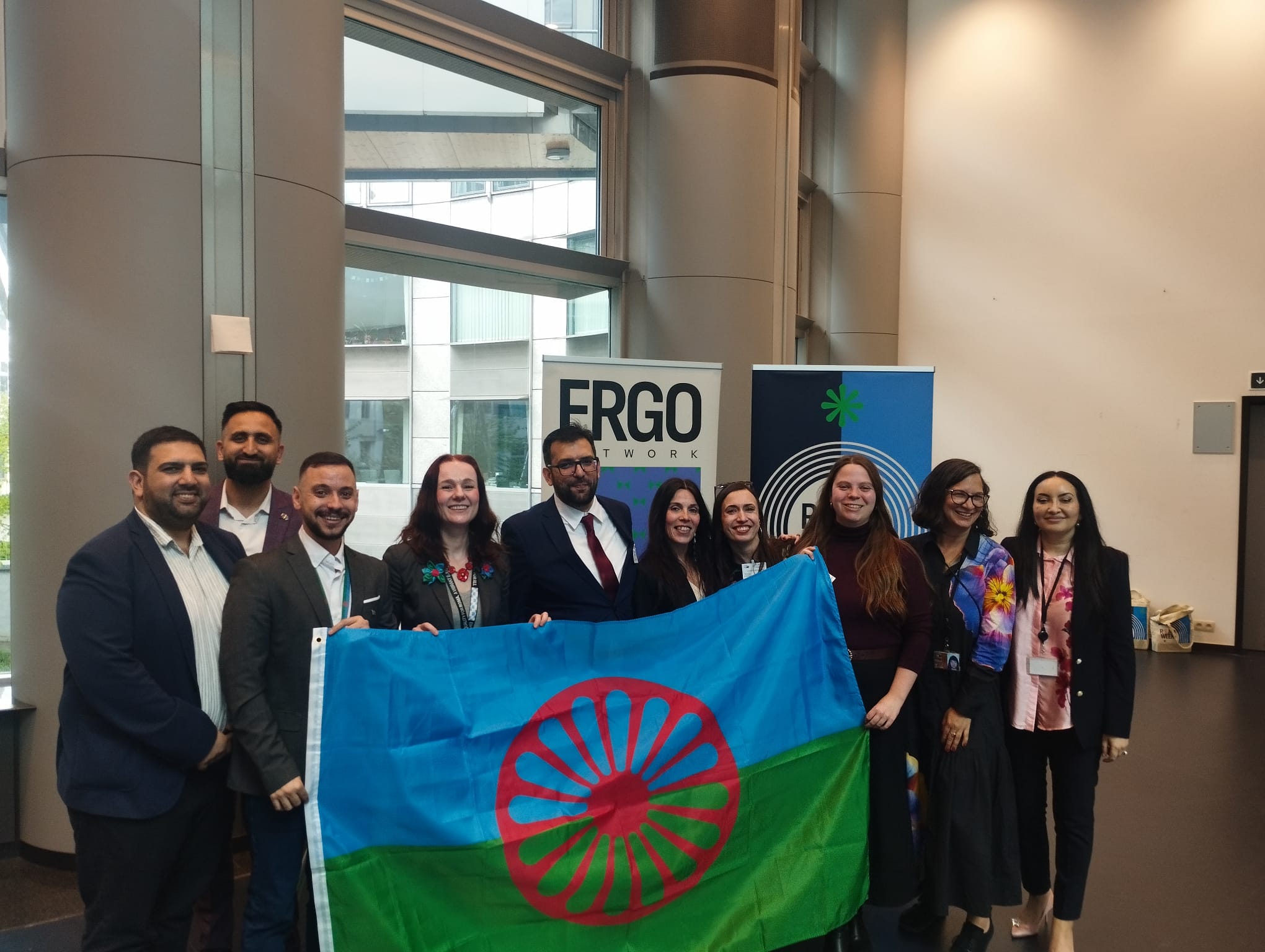

We participated in Roma Week 2026 in Brussels
Roma Week has been taking place annually in Brussels since 2016, around 8 April, the International Roma Day. It is organised by European institutions in cooperation with civil society organisations and brings together actors from politics, EU institutions, civil society and Roma communities. Its aim is to highlight the political and social situation of Roma in Europe, strengthen equality, participation and inclusion at EU level, and raise awareness of antigypsyism as a fundamental human rights issue.
This year, the Amaro Drom team once again took part in Roma Week from 20th to 22nd April and contributed to panels, expert discussions and dialogue formats. The programme focused on topics such as structural antigypsyism, education, remembrance of the genocide against Roma and Sinti, and political strategies at EU level. Through panels, workshops and discussions, concrete demands were formulated and perspectives from the communities were brought to light.
Beyond the formal sessions, informal formats such as evening events and smaller meetings created space for exchange and networking. These moments enabled direct dialogue between Roma youth and political representatives, connecting lived experiences with European policymaking.
—
Presentation of our TAAO project
—
A key moment for us was participating in a panel where Merdjan Jakupov and Konstantinos Gkantinas presented our project “Together Against Antigypsyism Online” (TAAO). As part of the project, young monitors from several EU countries collected and documented antigypsyist content on social media, which was then analysed by experts. In total, more than 3,000 posts were recorded. Many of them remained online despite containing dehumanising language and stereotypical portrayals.
The findings show how widespread antigypsyism is in the digital space and how insufficiently it has been addressed so far by platforms and policymakers. Roma and Sinti continue to be disproportionately targeted by hate speech, stereotyping and dehumanising narratives.
Online antigypsyism is not an isolated phenomenon. It reinforces existing prejudices, shapes public discourse and has direct consequences for the everyday lives of those affected.
This is why the issue must be addressed at European level. The EU Roma Strategy up to 2030 explicitly highlights the fight against antigypsyism as a key priority. The findings of TAAO contribute important evidence and outline concrete recommendations for more effective policy measures and stronger accountability.
At the same time, the presentation created space to highlight the perspectives of young Roma involved in the project and to bring their experiences into the European debate.